Nina is a teacher at Borns Friskola and has 21 students in grades 1 and 2 in her class. She has been using the Fiber weighted vest from Novista since December 2021. “At first, I thought only a few students would need the vest. But now about half of them use it—some occasionally, others more often.”
How did you first come across the Fiber Weighted Vest?
– I think I read about it somewhere. It might have been in one of the teachers’ magazines. This is a fantastic opportunity for the kids to try this out!
Nina believes it is important for the introduction to take place at the class level and has worked to create a supportive classroom environment where all assistive devices are permitted.
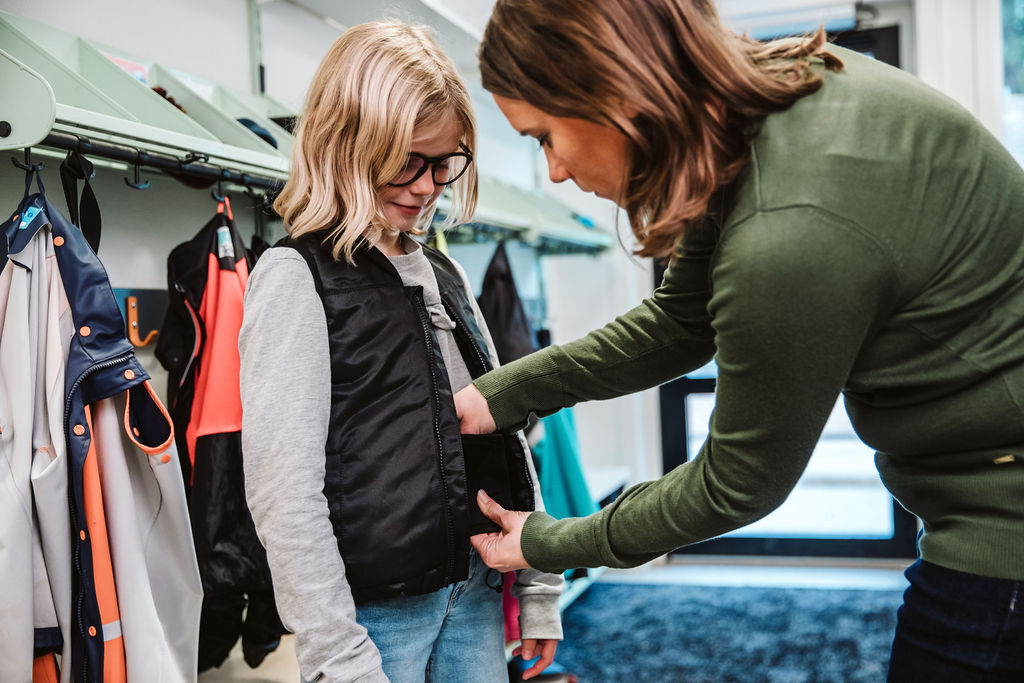
– I work with first and second graders. When we got the vests to try on, I put one on myself and told them we’d been lent something really cool. It’s a calm-and-relaxation vest that feels like a hug. All the kids got to try it on, and I tried to boost the vest’s status and make it something they’d want. Then I heard comments like, “I was able to work really hard on math when I had the vest on.”
“Guidelines for a Calm Classroom Environment”
Nina goes on to explain how the Fiberweight vest is used today. Every morning, the class gathers around a large mat, and she checks to see if any child is off-balance and asks if anyone needs the vest. Those who haven’t used it earlier in the week get priority, and if a student specifically asks for the vest, they’re allowed to use it, Nina explains.
What effects do you see in children who use weight vests?
– They feel calmer. It helps when they have a lot of thoughts and worries swirling around in their heads. My idea when I borrowed the vests was that they might help children with ADHD. But what I’m seeing is that most children find it very comforting to wear the vest. Everyone feels anxious sometimes, and it’s not always obvious to others. Anxiety can be invisible.
There are many assistive devices—what makes the Fiber Weighted Vest special?
– Novista’s weighted vest is more physical and enveloping; it helps in a deeper way than, for example, ear muffs that block out sound. The vest provides a pleasant sensation that spreads throughout the body. Screens and earmuffs take away—the vest adds, explains Nina. – The vest is flexible and discreet. It looks like a completely ordinary vest, not like an assistive device, she continues.

How did the school go about purchasing the weighted vests?
– I asked the principal if there was any extra money to buy assistive devices. The vests cost quite a bit, but if they can help even one child, then it’s worth it. It’s small change in the grand scheme of things.
Can you think of any other uses for the weighted vest?
– There are many factors that contribute to well-being. Many children find it easier to cope in a structured classroom with routines, and more difficult in unstructured settings, such as during lunch or in the cafeteria line. I think the vest would be a great help in these situations as well.
What advice would you like to share with others who are interested in trying the Fiber Weight Vest?
– The introduction is super important! Get the whole class involved and give it a name that the students will love. I called the vests “super vests,” and that made them interesting to the kids. It’s also important that all the kids try them on properly, just like with any other piece of equipment.
“Let all the students try it! More students than you think will want to use the vest. It’s not just for those who are thought to need it most—it’s for everyone. Because inner turmoil can be invisible,” Nina concludes.
Try a weighted vest or weighted collar free of charge for 14 days
It’s hard to know how the vest feels without trying it on, which is why we offer schools, preschools, businesses, and other organizations a customer satisfaction guarantee!
Here’s how it works: You order a vest or collar through our website and can try it on for 14 days. If you don’t want to buy the product, simply send it back after 14 days. You only pay if you decide to buy it. See conditions here.
To order via our website, please register an account here: https://www.novista.se/register/
Contact us at info@novista.se or 0431-49 13 10 for more information.
Would you like to read more about weighted vests in preschool, school, and educational settings? Learn more about weighted vests and weighted collars for schools here or check out our other articles: